Plant Care
Prepare Hydrangeas for Winter (Without Losing Next Year's Blooms)
Mea Cara · October 23, 2026 · 6 min read
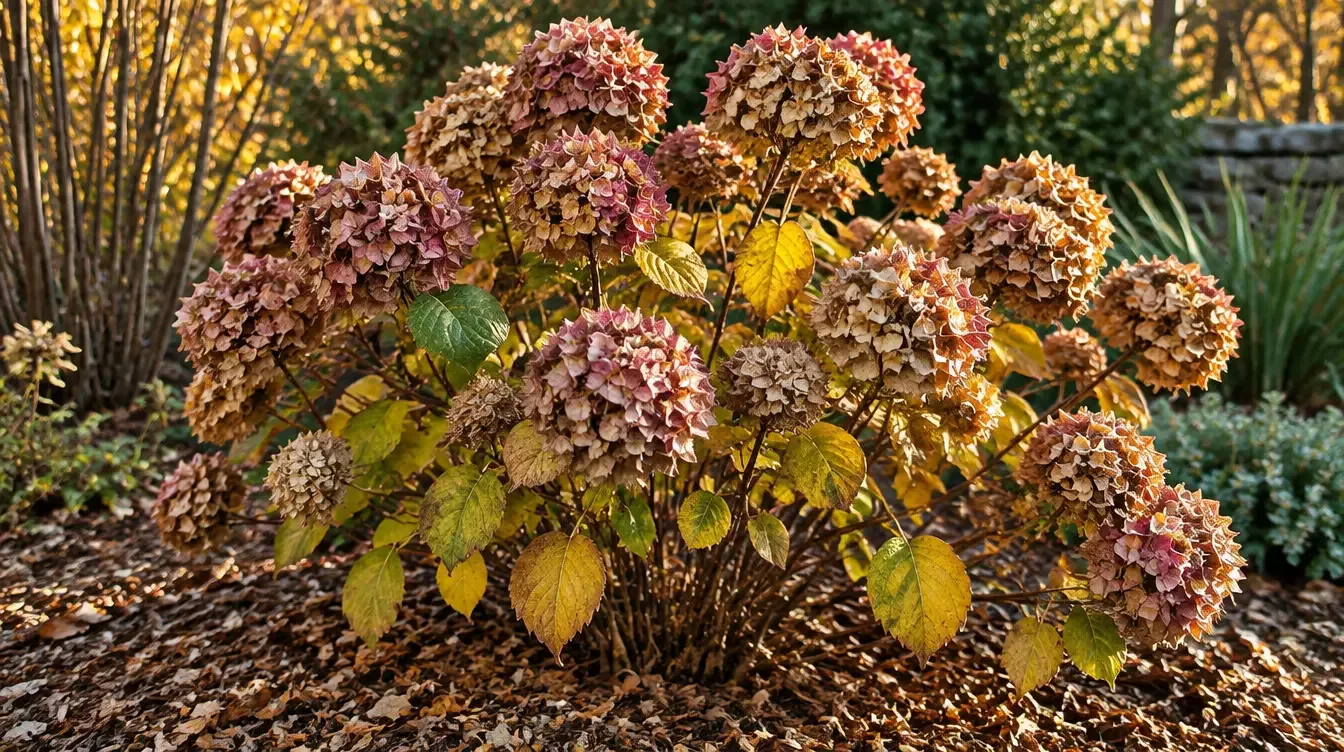
The hydrangea has gone the color of old paper, the flower heads are still on it, and every piece of advice you can find says something different. Cut it back. Do not cut it back. Wrap it. Leave it alone. A shrub that bloomed badly this year, or not at all, makes the question urgent, because you suspect that whatever you did last fall is the reason.
It probably was. Most hydrangea disappointment traces back to one fall job done to the wrong kind of hydrangea. Once you know which kind you have, the rest is short, and most of it is doing less than you expected.
First, which hydrangea do you have
Four kinds cover nearly every garden, and they divide into two groups that want opposite treatment.
- Bigleaf (Hydrangea macrophylla). The classic mophead or lacecap, with big, glossy, toothed leaves and flowers that run blue in acid soil and pink in alkaline. This is the one that fails to bloom after a hard winter or a fall haircut.
- Oakleaf (H. quercifolia). Lobed leaves like an oak's, peeling cinnamon bark, white cone-shaped flowers that age to pink, and good red fall color.
- Panicle (H. paniculata). Cone-shaped flowers that open white or lime and fade to pink or rust, on a shrub or small tree. Limelight and PeeGee are the common ones.
- Smooth (H. arborescens). Round white flower heads on a shrub that dies back nearly to the ground each winter. Annabelle is the one most people have.
Bigleaf and oakleaf bloom on old wood: the buds for next summer are formed this fall, on the stems that are standing now. Panicle and smooth bloom on new wood that grows in spring, so there is nothing on them to protect. Reblooming bigleaf types such as Endless Summer bloom on both, which means they forgive a cold winter but still bloom earlier and better if the old wood comes through.
The fall jobs, in order
- Stop feeding. No fertilizer after midsummer, and none now. Late nitrogen pushes soft growth that will not harden before frost and gives the old-wood types tender buds that freeze.
- Keep watering until the ground freezes. A deep soak every week or so through a dry fall, and one last thorough one after the leaves drop. A hydrangea that goes into winter dry loses more buds to desiccation than to cold, and the evergreen-looking stems of a bigleaf dry out fast in winter wind.
- Leave the flower heads on. They are not doing any harm, and on the old-wood types the dried heads give the buds beneath a little shelter. Snip them off in spring if you must, just above the first fat pair of buds.
- Cut nothing but dead wood. On bigleaf and oakleaf, the only fall pruning is removing stems that are plainly dead, which snap rather than bend and show no green when scratched. Panicle and smooth can be pruned, but late winter is the better time; there is no reason to do it now.
- Mulch after the ground has cooled. Two to three inches of shredded bark, shredded leaves, or compost over the root zone, kept an inch or two back from the stems. Wait until after a few hard frosts, usually November across most of the United States. Mulching warm soil in October holds heat in and delays dormancy, which is the opposite of what you want.
Protecting the buds in cold-winter climates
This is the job that decides whether a bigleaf hydrangea blooms. The flower buds on old wood are hardy to somewhere around 0 to 5°F, and a late spring frost after they have started to swell kills them just as well. Where winters reliably reach those temperatures, the buds need cover; where they do not, the shrub is fine with mulch alone.
The timing matters more than the method. Wrap only after the plant is fully dormant: the leaves have dropped and you have had several hard frosts, usually late November or early December. Wrapping a hydrangea that still has leaves traps moisture and warmth, invites rot, and stops it hardening off.
The simplest cover is a cylinder of wire fencing or chicken wire, a foot wider than the shrub on every side, filled loosely with dry leaves or straw to the top of the stems. Burlap wrapped around stakes works too, with leaves inside; plastic does not, because it sweats. In early spring, when the worst of the cold is past and the buds along the stems begin to swell, unpack it over a week or two so the stems are not shocked by a late frost. If a frost is forecast after the leaves are out, an old sheet thrown over the shrub for the night is worth the trouble.
Oakleaf hydrangeas are hardier and seldom need wrapping except in the coldest gardens or in an exposed, windy spot. Reblooming bigleafs should be protected anyway; they will bloom on new wood without it, but late and sparsely.
What people get wrong
The fall haircut, above all. A bigleaf hydrangea cut to the ground in October has had every flower bud for next year removed, and it will spend next summer as a handsome green mound. Panicle and smooth hydrangeas do not mind, which is how the habit spreads: someone cuts their Annabelle back, it blooms beautifully, and the neighbor does the same to a mophead.
The second is impatience in spring. A bigleaf hydrangea leafs out late, often from the base first, and the top of each stem can look dead well into May. Wait until the plant has leafed out fully before cutting anything, then take out only what is truly dead down to the first live buds. Stems that look like dry sticks in April are often carrying the flowers.
And if a bigleaf planted in a cold-winter garden has never bloomed in three years, the honest answer may be that it never will there, however carefully you wrap it. A panicle hydrangea in the same spot will bloom every year with no help at all.
What to write down
Which kind each hydrangea is, by name and by plant. It sounds obvious, and in five years, with three shrubs from three sources, it is not. Then two dates: the day you wrapped it and the day you unpacked it in spring, with a note of what the buds looked like. Next year, a photo of the shrub in full bloom with a rough count of flower heads tells you whether the winter protection earned its keep or whether that plant would be happier somewhere else.
Deep watering and a late mulch are two of the jobs on the fall checklist, and which-hydrangea-is-which is exactly the kind of fact a garden journal keeps so you do not have to. GardenBinder is free to start, and a photo of the shrub with its name and the date is the whole entry.
#hydrangeas #winter #shrubs #pruning #frost